


Fall Quarter 2026
- For day, time, room, and TA information, see our PDF Schedule or the Schedule Builder
- For all courses not described here, please refer to the General Catalog course descriptions:
Lower Division
- JPN 001 Elementary Japanese, 14 Sections
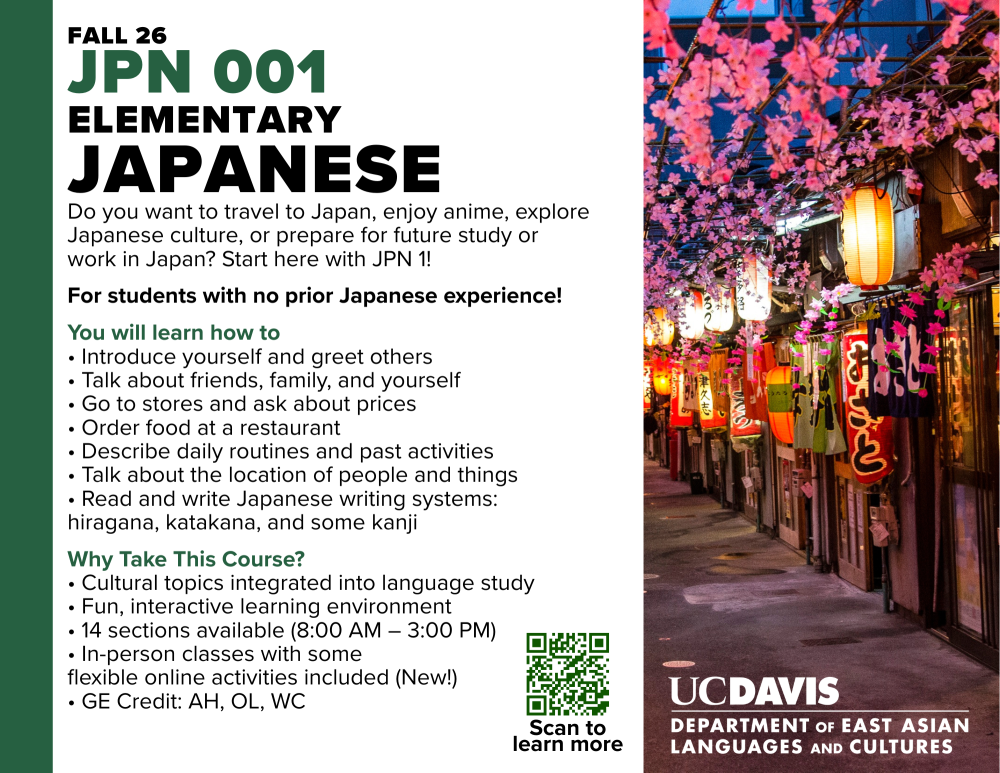
Do you want to travel to Japan, enjoy anime, explore Japanese culture, or prepare for future study or work in Japan? Start here with JPN 1!
For students with no prior Japanese experience!
You will learn how to
• Introduce yourself and greet others
• Talk about friends, family, and yourself
• Go to stores and ask about prices
• Order food at a restaurant
• Describe daily routines and past activities
• Talk about the location of people and things
• Read and write Japanese writing systems: hiragana, katakana, and some kanji
Why Take This Course?
• Cultural topics integrated into language study
• Fun, interactive learning environment
• 14 sections available (8:00 AM – 3:00 PM)
• In-person classes with some flexible online activities included (New!)
• GE Credit: AH, OL, WC
- JPN 004 Intermediate Japanese, 4 Sections
- JPN 025 Japanese Language & Culture (in English) | Nobuko Koyama
- Classification and communication of experience in Japanese culture; principles of language use in Japanese society. Speech levels and honorific language, language and gender, minority languages, literacy. Role of Japanese in artificial intelligence and computer science.
Upper Division
- JPN 101 Japanese Literature in Translation: The Early Period | David Gundry
- Course Description: Study of early Japanese literature from the Nara to the end of the Heian period through a broad survey of the major literary genres such as lyric poetry, court diaries, prose narratives, poem-tales, and classical Chinese writings.
- JPN 111 Modern Japanese: Reading & Discussion
Course Description: Readings in modern Japanese short stories, newspaper articles, and essays; conversation practice based on these readings. Prerequisite(s): JPN 006 C- or better; or the equivalent language proficiency
Section 1: Moeko Watanabe
Section 2: Miyo Uchida- JPN 121 Advanced Japanese I | Nobuko Koyama
The goal of JPN 121 and 122 is to prepare students for their life after school—seeking professional careers in Japan, pursuing graduate degrees in Japan, or traveling/living in Japan. Thus, students are strongly encouraged to take both (121, 122) to acquire “real-life” skills to function as an independent thinker in the Japanese society. For instance, to land a job in Japan, you need to be able to perform the following: Writing a personal statement, writing a resume, making email inquiries, presenting yourself at a job interview by using the socioculturally appropriate style (i.e., keigo, business decorum, sociocultural norms). Similarly, if you pursue higher degrees at graduate school in Japan, you are expected to know a variety of genres (both reading and writing) including academic articles, research proposal, term papers, writing CV and so forth. All these are “real-life” skills.
- JPN 136 Readings in Japanese Newspapers | David Gundry
Course Description: Fourth-year level reading of newspaper articles and other journalism in Japanese on a wide variety of subjects.
Prerequisite(s): JPN 113; or equivalent language proficiency, or consent of instructor.- JPN 153 Love, Sexuality & the Family in Modern Japanese Literature | Michiko Suzuki
- Love and sexuality in their various forms have been a central topic for exploration by writers of modern and contemporary Japanese literature from the late 19th century to the present. While such concepts reflect universal human experiences, they are also rooted in specific historical and cultural contexts. The family as a social, cultural and legal institution profoundly informs literary examinations of love and sexuality, including issues of normativity and deviance, love within and outside of family ties, different forms of marriage/divorce, gender roles, and the struggle between the family and the individual. By examining texts written over a hundred-year period, we will gain a deeper understanding of literary narratives through their engagement with the evolving institution of family and with changing ideas of love and sexuality. We will focus mainly on novels and short stories, but also read several secondary articles on literary criticism, history, religion and sociology. GE: AH, WC, WE
- JPN 155 Intro to Japanese Folklore | Michael Foster
- From sacred myth to urban legend and everything in between, the folklore of Japan is rich and varied. There are epics of war; folktales about ghosts and shapeshifting creatures; local festivals that have persisted for hundreds of years; and new traditions created in the context of globalization and cultural change. This course introduces students to Japanese folklore and its study (minzokugaku). Primary emphasis is on the narrative genres of myth, legend, and folktale, but we will also discuss folk beliefs, ritual, festival and supernatural creatures. We will consider issues of identity and what it means to call something “Japanese”; questions of tradition and “invention of tradition”; modernity within a Japanese historical context; and the intersection of folklore with literature and popular culture. We will also study the history of minzokugaku as a discipline, its development in prewar Japan, as well as its (mis)use for nationalist purposes. This course allows us to explore important cultural products that are often overlooked in classes on literature, anthropology, and history. All required readings are in English. No previous knowledge of Japanese language or culture is required.
- JPN 160 Japanese Food Culture | Michael Foster
- Course Description: Study of Japanese food and the culture of eating and drinking in Japan. Attention to symbolism, historical development, aesthetics, identity and global contexts. Materials examined include critical sources as well as literary texts, art, and films.